



Shiping Information
Which container does my freight need?
When shipping your ocean freight, it is useful to know which type of container best suits your goods. More Information
Which incoterms apply to my shipment?
Incoterms ensure that both the buyer and the seller know what their obligations, costs and risks are. More Information
What type of pallet do I need?
Pallets are used in freight shipping to protect your goods. Also for carriers, pallet shipping makes freight handling more efficient and helps maximize trailer space. More Information
You can avoid extra costs with container freight.
Hidden costs in container freight can become quite the surprise when the final invoice arrives – here are some tips to understanding some extra costs that may arise when importing container freight. More information
Ocean Freight Containers
If you have a lot more freight to send than you ever have before – great! Business is booming! You’ve moved from LCL (less than container load) to FCL (full container load) freight.
You might be wondering what size container to use? Are there different types of shipping containers?
There are many different sizes and types of shipping container. When shipping cargo it is helpful to know what type of shipping container will best suit your needs. Often the dimensions and maximum weight will impact on what type of equipment can be used.
The following guide shows the different types of shipping containers that can be used as a starting point for determining your shipping requirements.
Note: Exact dimensions can differ slightly due to manufacturer, and load regulations may restrict operation to less than maximum weight. Use this information as a guide only.
| Container Type | Internal Dimensions (L x W x H) |
Door Opening (W x H) |
Cubic Capacity | Cargo Weight | |
|---|---|---|---|---|---|
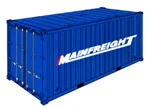 |
20FT General | 5.89 x 2.35 x 2.36m | 2.33 x 2.26m | 33m³ | 21,700kgs |
| 20FT High Cube | 5.89 x 2.35 x 2.69m | 2.33 x 2.59m | 37m³ | 21,700kgs | |
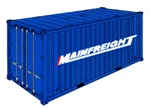 |
40FT General | 12.05 x 2.35 x 2.36m | 2.33 x 2.26m | 66m³ | 26500kgs |
| 40FT High Cube | 12.05 x 2.35 x 2.69m | 2.33 x 2.59m | 76m³ | 26500kgs |
Notes –
- Heavy Rated shipping containers which support a heavier load are available, additional surcharges may apply
- Food Grade shipping containers for carrying foodstuffs are available, additional surcharges may apply
- A 20FT High Cube shipping containers (higher height that standard) are only available for designated origin/destination pairings
- Additional charges may apply for High Cube containers
| Container Type | Internal Dimensions (L x W x H) |
Door Opening (W x H) |
Cubic Capacity | Cargo Weight | |
|---|---|---|---|---|---|
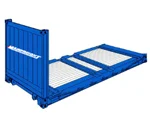 |
20FT Flat Rack with sides |
5.89 x 2.35 x 2.23m | Side Opening W – 2.59m |
30m³ | 26500kgs |
| 20FT Flat Rack without sides |
6.00 x 2.35 x 0.23m | 33m³ Max Height 2.36m |
23500kgs | ||
| 40FT Flat Rack with Sides |
12.05 x 2.35 x 2.23m | Side Opening W – 11.66m |
63m³ | 3600kgs | |
| 40FT Flat Rack without sides |
12.20 x 2.35 x 0.65m | 67m³ Max Height 2.36m |
39000kgs |
Notes –
- This shipping container is used for over-dimensional (out of gauge) cargo. It is available with or without sides
- Survey reports may be required when shipping out of gauge cargo
- If out of gauge additional surcharges will apply
- Flat Rack containers are subject to availbility and additional surcharges will apply
| Container Type | Internal Dimensions (L x W x H) |
Door Opening (W x H) |
Cubic Capacity | Cargo Weight | |
|---|---|---|---|---|---|
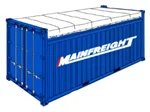 |
20FT Open Top | 5.89 x 2.35 x 2.36m | 2.33 x 2.29m | 32m³ | 21700kgs |
| 40FT Open Top | 12.05 x 2.35 x 2.36m | 2.33 x 2.29m | 66m³ | 26500kgs |
Notes –
- Open top containers allow you to load over height cargo or allows easier loading by crane
- If out of gauge additional surcharges will apply
- Open Top containers are subject to availbility and additional surcharges will apply
| Container Type | Internal Dimensions (L x W x H) |
Door Opening | Cubic Capacity | Cargo Weight | |
|---|---|---|---|---|---|
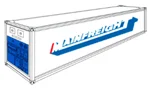 |
20FT Reefer | 5.44 x 2.26 x 2.24m | 2.26 x 2.20m | 27m³ | 21700kgs |
| 40FT Reefer | 11.55 x 2.26 x 2.24m | 2.26 x 2.20m | 58m³ | 25000kgs |
Notes –
- Refrigerated shipping containers can be set at a required temperature for the duration of the voyage
- Commonly used for food/dairy products
- The smaller dimensions are due to thicker walls
- Reefer containers are subject to availbility and additional surchrges will apply
Incoterms
What are Incoterms?
Incoterms – a.k.a. Trade Terms are key elements of international contracts of sale. They tell the parties what to do with respect to carriage of the goods from buyer to seller, and export & import clearance. They also explain the division of costs and risks between the parties.
The ICC has launched the Incoterms 2020, which is effective from the 1st of January 2020. The Incoterms 2020 does not contain major changes, it is providing more clarity on how to use the Incoterms. The most important difference is in the Incoterms 2020 a new Incoterm DPU (Delivered at Place Unloaded) replaces the Incoterms DAT (Delivered at Terminal). The place of destination can be any place and does not have to be a terminal.
What does this all mean?
Here is a simple explanation of all terms:
For all modes of Transport
EXW – Ex Works (….named place of delivery)
FCA – Free Carrier (…named place of delivery)
CPT – Carriage Paid To (…named place of destination)
CIP – Carriage And Insurance Paid To (…named place of destination)
DPU – Delivered At Named Place, Unloaded (named address/place of destination)
DAP – Delivered At Place (…named address/place of destination)
DDP – Delivered Duty Paid (…named address/place of destination)
Ocean freight usage only
FAS - Free Alongside Ship (...named wharf/seaport)
FOB – Free On Board (…named wharf/seaport of shipment)
CFR – Cost And Freight (…named port of destination)
CIF – Cost Insurance And Freight (…named port of destination)
INCO Terms get updated periodically. The full current list of INCO Terms (2020) is available for purchase on the ICC website. Download Mainfreight’s Incoterms 2020 Quick Reference Guide here.
Pallet and Packaging types
Below you will find information on pallets and several types of packaging.
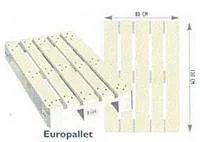
Euro pallet
Standard size (L × W) = 800 mm × 1200 mm
Maximum pay load = 1000 kg*
Empty weight = 25 kg
* If the pallet is of good quality.
A Euro pallet is always marked as a Euro pallet using several abbreviations like:
- EUR
- DB
These are the most common abbreviations. Unfortunately there are also fake Euro pallets. These are Ewpallets (one way pallet) falsely marked with the abbreviation EUR without the ring around it. A false Euro pallet can be recognized by the thickness of the wooden planks. (1 cm in stead of 2 cm). Unfortunately we are forced to regard a false Euro pallet as a EWPALL and cannot exchange these pallets.
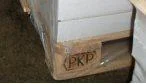
UIC withdraws the PKP the right to grant the trade mark
The UIC (Union Internationale des chemins de fer) has withdrawn the Polish Railways PKP the right to grant the protected trade mark. This means that all Europallets marked with the sign of the Polish Railways PKP cannot be exchanged within the Europalletpool and are considered as trade mark imitations and will be withdrawn from circulation and destroyed by the European Pallet Association (EPAL) with the help of the customs and police.
This decision has been taken because Euro pallets manufactured in Poland by PKP are of bad quality and have damaged the Quality Trade Mark Euro pallet.
EU countries participating in the exchange system
For Euro pallets there is an exchange system in the following EU-countries:
- Belgium
- Netherlands
- Luxembourg
- Germany
- Austria
- Switzerland
Outside these countries shipping goods on a Euro pallet is unwise because there is no exchange system and these Euro pallets should be considered lost. This loss cannot be claimed at the Logistic Service Provider.
Blok pallet
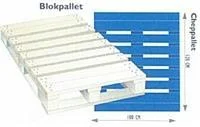
A “blok pallet” is not an official pallet size within Europe. Usually the size is 100 × 120 cm.
Standard sizes (L × B) = usually 1000 mm × 1200 mm
Maximum pay-load = 1250 kg*
Empty weight = depending on size and type of wood
*If the pallet is of good quality.
Chep pallet
For Chep pallets there is an exchange system within the Netherlands. Outside the Netherlands it is not advisable to ship your goods on a Chep pallet because these are rental pallets and are not always accepted/ cannot be swapped at the unloading address. The freight forwarder is not responsible for pallets which were not swapped at the unloading address.
Standard sizes (L × B) = 1000 mm × 1200 mm
Maximum pay-load = 1250 kg*
Empty weight = 30 kg
*If the pallet is of good quality.
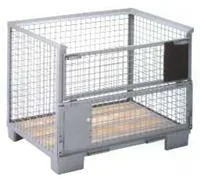
Gitterbox
Sizes inside (L × W × H) = 115 × 75 × 105 cm
Sized outside (L × W × H) = 123 × 80 × 105 cm
Maximum pay-load = 1250 kg*
Empty weight = 70 kg
*If the pallet is of good quality.
There are exchange systems for gitterboxes in some countries. The boxes must comply with the DIN 15155 standard.
Tips to avoid extra costs with container freight
A few hidden costs can arise from time to time. It’s important that you understand what they are so you can avoid them – one such hidden cost is container demurrage.
What is demurrage?
Demurrage is a fee from the shipping lines for the use of their shipping containers. You are permitted a limited number of free days (these will vary depending on the carrier and location). Containers not returned within the allotted free time are subject to additional fees by the shipping lines: demurrage.
Why do Shipping lines charge demurrage?
The charge is imposed to encourage you the consignee to load and unload in a timely manner.
Does the demurrage charge vary?
Yes. The demurrage charge may differ from carrier to carrier and from port to port.
The charges also tend to increase per day after exceeding a certain amount of days.
What are the main causes of demurrage?
Time. Delays can occur from a multiple of places from congestion at the port, full payment to customs paperwork.
Tips to consider
- Planning – share cargo and shipment delivery instructions with all parties including carrier, vendors and third party providers for smooth loading and unloading process and to avoid any delays.
- Understand all required documents.
- Have a back-up plan in case of port congestion and also have a list of alternative routes to use just in case.
- Shippers can sometimes negotiate for extended free times.
Can Swing Freights assist?
Yes. To assist you to manage your container deliveries and empty returns to avoid unnecessary costs associated with container demurrage we have a container demurrage alert system in place. The system links our freight systems with both wharf and external carrier systems to update electronically with container availability and de-hire information. This allows us to assist our customers in monitoring deliveries with an automatic alert sent at set intervals advising allocated free time remaining on a container.